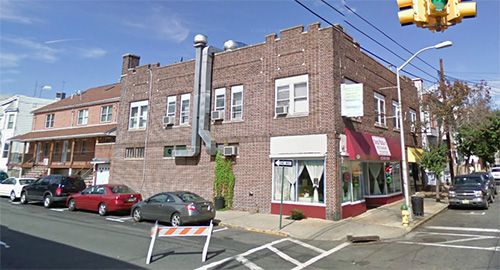
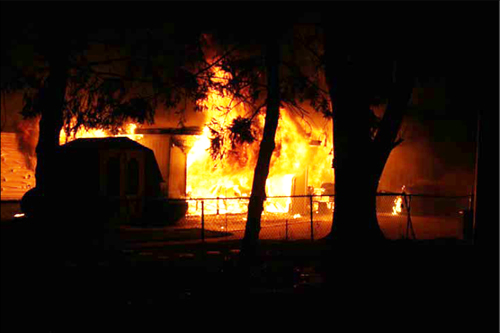
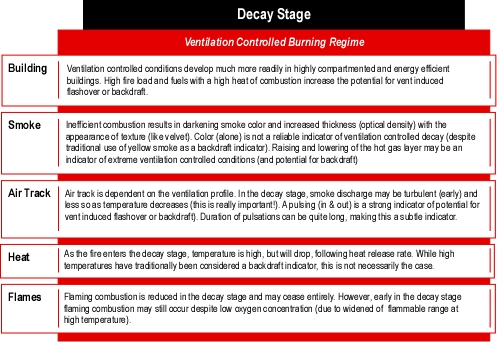
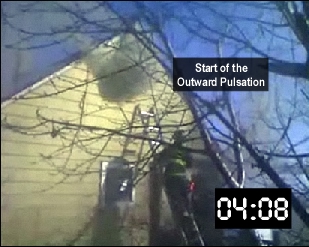
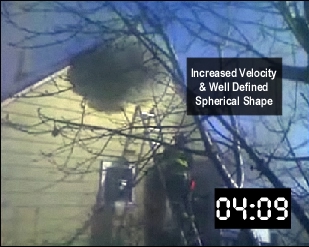
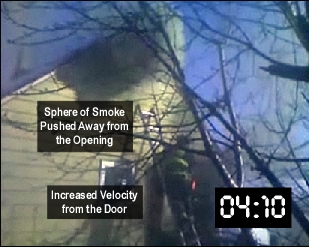
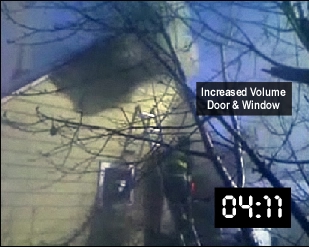
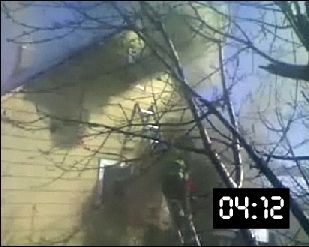
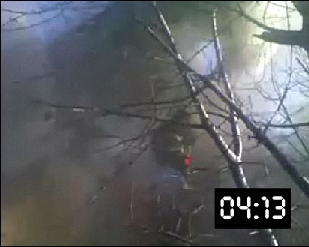
On March 10, 2013 five Harrison, New Jersey firefighters were injured in an explosion while working at a commercial fireat 600-602 Frank E. Rodgers Boulevard. The fire originated in a two-story commercial building at the corner of Frank E. Rodgers Boulevard North and Davis Street and extended into Exposures Charlie and Delta, two-story residential buildings.
Figure 1. Alpha/Bravo Corner and Exposure Charlie
Image from Google Maps, click on the link to walk around using Street View.
Reading the Fire
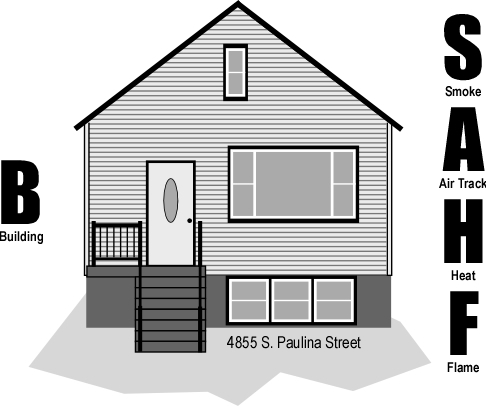
Before watching the video (or watching it again if you have already seen it), download and print the B-SAHF Worksheet. Using the pre-fire photo (figure 1) and observations during the video, identify key B-SHAF indicators that may have pointed to potential for extreme fire behavior in this incident.
Important! Keep in mind that there is a significant difference between focusing on the B-SAHF indicators in this context and observing them on the fireground. Here you know that an explosion will occur, so we have primed the pump so you can focus (and are not distracted by other activity).
Backdraft or Smoke Explosion
While smoke explosion and backdraft are often confused, there are fairly straightforward differences between these two extreme fire behavior phenomena. A smoke explosion involves ignition of pre-mixed fuel (smoke) and air that is within its flammable range and does not require mixing with air (increased ventilation) for ignition and deflagration. A backdraft on the other hand, requires a higher concentration of fuel that requires mixing with air (increased ventilation) in order for it to ignite and deflagration to occur. While the explanation is simple, it may be considerably more difficult to differentiate these two phenomena on the fireground as both involve explosive combustion.
Did you observe any indicators of potential backdraft prior to the explosion?
Do you think that this was a backdraft?
What leads you to the conclusion that this was or was not a backdraft?
If you do not think this was a backdraft, what might have been the cause of the explosion?
For more information in Backdraft, Smoke Explosion, and other explosive phenomena on the fireground, see:
I would like to say thanks to all of you who have sent e-mail or contacted me on Facebook inquiring about the status of the CFBT-US blog. The last several years have been extremely busy at Central Whidbey Island Fire & Rescue and my focus has been almost exclusively on the fire district. However, I am renewing my commitment to developing knowledge of practical fire dynamics throughout the fire service and will endeavor to return to posting on a regular basis. In addition, I am working on a series of short (10-minute) drills on fire dynamics that will be cross posted on the CFBT Blog and the Fire Training Toolbox.
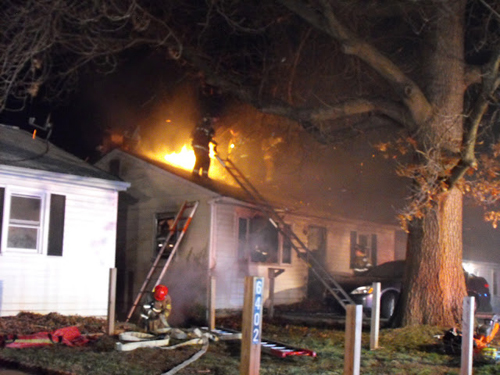
Seven firefighters were tragically injured in Prince George’s County Maryland on Friday, February 24, 2012. The fire broke out in the basement of a single-family, one-story house located at 6404 57th Avenue in Riverdale, MD shortly after 21:00 hours.
Note: View from Alpha-Bravo Corner street side. Photo by Billy McNeel.
On arrival, Engine 807B reported a two-story, single family dwelling with fire showing from the basement level on Side Bravo. Seven members from Companies 807 (Riverdale) and 809 (Bladensburg) entered Floor 1 of the building on Side A (East Side) and within eight seconds were enveloped by untenable, wind driven fire conditions. Preliminary reports indicate that firefighters had initiated an interior attack on the fire when a sudden rush of air, fanned by high winds, entered from the rear of the house either from a door or window being opened or broken out. (Brady, 2012). A report on Monday, February 27 indicated that some of the firefighters ran to the back of the one-story home, then entered through a basement door while other members of their company opened the front door in search of a victim (FirefighterNation, 2012).
In a statement to Washington Post reporter J. Freedom du Lac (2012), Chief Marc Bashoor indicated that strong winds were gusting out of the west at up to 40, 45 mph, blowing directly into the burning basement, which had a west-facing door. “As soon as the guys opened the front door and advanced, it blew from the basement, up the steps and right out the front door,” Bashoor said. “It was like a blowtorch coming up the steps and out the door… Without that wind, the hot air and gases would have been venting out of the rear of the house,” he said. “The current of air essentially produced a chimney right up the steps and out the front door.” (Washington Post, 2012).
Firefighters Ethan Sorrell and Kevin O’Toole from Bladensburg Volunteer Fire Department remain in critical condition at Washington Hospital Center. Riverdale Volunteer, Michael McLary also remains hospitalized for injuries. The other injured firefighters were released and sent home Saturday evening according to the latest reports.
The wind-fueled fireball that injured seven Prince George’s County firefighters when it blew through the burning house they had just entered was “a freak occurrence,” a department spokesman, Mark Brady, said Saturday (du Lac, 2012).
Dealing with an accident involving a serious injury or fatality is extremely difficult, particularly when the complete circumstances and eventual outcome is unknown. What may appear to be obvious in retrospect may also have been not so clear to the individuals engaged in emergency operations. However, one might ask if the fire behavior encountered at 6404 57th Avenue in Riverdale, MD was in fact a freak occurrence. A freak is defined as a thing or occurrence that is abnormal, markedly unusual or irregular.
The conditions encountered were markedly different than usually encountered in fires occurring in single family dwellings. However, the conditions described in this incident are not unusual when considered in light of the building configuration and wind conditions at the time of the incident. Wind, flow path, and burning regime (fuel or ventilation controlled) have a tremendous impact on fire behavior and potential for rapid fire progression resulting in untenable conditions.
Wind Driven Fires
On April 16, 2007 Technician Kyle Wilson of the Prince William Fire & Rescue lost his life in a wind driven fire occurring in a large, single family dwelling. In the introduction to the investigative report produced by Prince William Fire & Rescue examining this incident, Chief Kevin J. McGee states:
First, the impact the wind had on this event was significant. While weather conditions, and specifically wind, are often discussed in the firefighting environment of wildland fires, it does not receive the same attention and consideration in structure fires. This incident showed the dramatic and devastating effect the wind can have on the spread of fire in a building. The wind forced the fire into the building and caused the sudden change in fire conditions inside, including the “blowtorch” effect witnessed by the crews on the scene (Prince William County Fire Rescue, 2008)
In January, the National Institute of Standards and Technology (NIST) released Simulation of the Dynamics of a Wind-Driven Fire in a Ranch-Style House-Texas (Barowy & Madrzykowski, 2012) examining fire behavior in the incident that took the lives of Houston Fire Department Captain James Harlow and Firefighter Damion Hobbs on April 12, 2009 while engaged in firefighting operations in a single family dwelling. This report emphasized that potential for wind driven fire conditions can occur in all types of buildings, including single-family residential structures.
NIST research (Madrzykowski & Kerber.(2009a, 2009b) has identified that wind driven fire conditions can be created with wind speeds as low as 4.5 m/s (10 mph) and that while structural fire departments have recognized the impact of wind on fire behavior, in general, standard operating guidelines (SOG) have not changed to address the risk of wind driven fires (Barowy & Madrzykowski, 2012).
Previous posts have examined NISTs research on the issue of wind driven fires:
On May 30, 1999, Firefighters Anthony Phillips and Louis Matthews of the District of Columbia Fire Department (DCFD) died and two others were severely injured as a result of rapid fire progression while engaged in firefighting operations at 3146 Cherry Road, NE. The fire occurred in the basement of a two-story, middle of building, townhouse apartment. Crews entered on Floor 1, Side A and were caught in the flow path of hot smoke and flames when a sliding glass door was opened at the Basement Level on Side C. Previous posts examined this incident in detail:
More recently, the City of San Francisco Fire Department released an investigative report examining the circumstances surrounding the deaths of Lieutenant Vincent Perez and Firefighter/Paramedic Anthony Valerio on June 2, 2011 while operating at a fire in the basement of a two story home with two levels below grade. Failure of a basement window placed the Lieutenant and Firefighter in the flow path between the basement window and their entry point on Floor 1. The investigative report produced by the San Francisco Fire Department details their findings and recommendations related to this incident.
Research and fireground experience point to the following:
Building configuration including windows, doors, and open interior stairways can have a significant impact on development of a flow path from the fire to one or more exhaust points.
Introduction of additional air to a ventilation controlled fire (without concurrent fire suppression) will quickly result in increased heat release rate.
Creation of openings at and above the fire level which result in a flow path with an exhaust opening above the inlet will result in a rapid increase in heat release rate.
Thermal conditions in the flow path above the fire and/or downstream from the fire location or will quickly become untenable.
Even limited wind conditions can result in wind driven fire conditions.
These factors in combination are even more likely to result in rapid fire progression and untenable conditions in the downstream flow path.
It is essential that Firefighters and Fire Officers recognize the influence of ventilation on fire behavior and potential for wind driven fire conditions and adjust their strategies and tactics accordingly. The following guidance is based on recommendations developed through the NIST wind driven fires research as well as data from National Institute for Occupational Safety and Health (NIOSH) death in the line of duty reports and incident investigative reports by the Texas State Fire Marshals Office.
Potential for wind driven conditions increases directly with wind speed. When wind speeds exceed a gentle breeze (8-12 mph) consider the potential for wind driven fire conditions and apply the following strategic and tactical considerations (CWIFR District Board, 2011):
If potential for wind driven fire conditions is identified, this should be communicated to all companies and members working at the incident as a safety message.
When possible, operate from the exterior and apply water from upwind directly into the involved compartments prior to interior attack. Even low flow exterior streams applied from upwind can have a significant impact on controlling the fire prior to interior operations).
In a wind-driven fire, it is most important to use the wind to your advantage and attack the fire from the upwind side of the structure, especially if the upwind side is the burned side. Note that this may be contrary to conventional offensive tactics that place hoselines between the hazard presented by the fire and potential occupants and uninvolved property.
Avoid pressurization of the building without first establishing adequate exhaust openings (2-3 times larger than the inlet). Remember that wind can create the same (or greater) positive pressure as a blower used in positive pressure ventilation (PPV). Pressurization without adequate exhaust can result in extreme fire behavior. Note: This is particularly important when the fire is on the leeward (downwind) side of the building and entry is made from the windward (upwind) side of the building.
Consider controlling the flow path by using anti-ventilation such as door control and limiting the use of (horizontal and vertical) tactical ventilation prior to fire control. However, it is essential to remember that unplanned ventilation resulting from fire effects can have a significant impact on the ventilation profile and subsequent flow path(s).
Avoid working in the exhaust portion of the flow path (between the fire and exhaust opening) or potential flow paths (between the fire and potential exhaust openings). Unplanned ventilation from fire effects can suddenly change the interior thermal conditions.
Identify potential refuge areas, escape routes, and safety zones prior to and during interior operations. Taking refuge in a compartment with an intact and closed door may temporarily provide tenable conditions and a place of refuge until the fire can be controlled or another avenue of egress established.
Central Whidbey Island Fire & Rescue (CWIFR) District Board. (2011). Board minutes February 9, 2012. Coupeville, WA: Author. [Adoption of Purpose, Policy, and Scope of SOG 4.3.6 Structural Firefighting Under Wind Conditions]
District of Columbia (DC) Fire & EMS. (2000). Report from the reconstruction committee: Fire at 3146 Cherry Road NE, Washington DC, May 30, 1999. Washington, DC: Author.
Madrzykowski, D & Kerber, S. (2009a). Fire fighting tactics under wind driven conditions: Laboratory experiments, TN 1618. Retrieved February 8, 2012 from http://fire.nist.gov/bfrlpubs/fire09/PDF/f09002.pdf
Madrzykowski, D & Kerber, S. (2009b). Fire fighting tactics under wind driven fire conditions: 7-story building experiments, TN 1629. Retrieved February 8, 2012 from http://fire.nist.gov/bfrlpubs/fire09/PDF/f09015.pdf
Madrzykowski, D. & Vettori, R. (2000). Simulation of the Dynamics of the Fire at 3146 Cherry Road NE Washington D.C., May 30, 1999, NISTR 6510. August 31, 2009 from http://fire.nist.gov/CDPUBS/NISTIR_6510/6510c.pdf
There were multiple near miss incidents and injuries involving flashover during the month of December. These incidents point to the importance of understanding fire dynamics and reading the fire as part of initial size-up and ongoing dynamic risk assessment. Each member operating on the fireground must maintain a high level of situational awareness and communicate key fire behavior indicators and potential for extreme fire behavior phenomena.
Flashover Disrupts Firefighters’ Rescue Effort
Firefighters attempting to rescue a victim from a burning Portsmouth (VA) house on Thursday were forced to abandon the rescue attempt and exit a window when a flashover occurred.
Firefighters first entered the home through the front door, but were repelled by flames. They then made entrance through the front bedroom windows when the flashover occurred. After escaping, firefighters tried to reenter through the back of the house, but they could not.
“An Ottawa firefighter had to be rescued from a burning basement after he was caught in a possible flashover yesterday afternoon. We don’t know what happened, and we haven’t had a chance yet to look into exactly what the details were, but we have a feeling that it might have been a flashover,” department spokesman Marc Messier said.
“Flames were coming up from the basement and out of the windows when crews arrived at the Dana Avenue house fire. There was a flashover, and fire crews quickly evacuated the duplex. Two firefighters were injured in the flashover, Battalion Chief David Whiting” said.
When they arrived, flames were coming from the first and second story of the house, firefighters said.
Kansas City, Mo., Fire Chief Smokey Dyer tells KMBC 9’s Justin Robinson what happened in a fire early Saturday that left three firefighters injured
Kansas City Fire Chief Smokey Dyer said crews went inside and started to go up the stairs, when conditions inside the house suddenly changed. He said it burned the fire hose and left the firefighters completely surrounded by flames. The firefighters sent out a mayday call for help.
“In the past 10 years, every significant firefighter injury that we have sustained in fire combat has been a result of a rapid change of conditions,” [emphasis added] Dyer said.
Incidents such as these point to the need for continued emphasis on developing firefighters’ understanding of practical fire dynamics and effective strategies and tactics to control the fire environment and prevent, rather than react to occurrence of fire phenomena such as flashover.
Flashover is Just Flashover
In a recent discussion with a number of international colleagues, we were challenged to think about language, terminology, and precision when describing fire phenomena. While this is a more obvious challenge when working with firefighters, researchers, and scientists who have different first languages, it is also a day to day problem for firefighters with a common native language (e.g., English).
Consider two recognized definitions for flashover:
Stage of fire transition to a state of total surface involvement in a fire of combustible materials within an enclosure’ (ISO 13943, 2008, 4.156).
A transitional phase in the development of a compartment fire in which surfaces exposed to thermal radiation reach ignition temperature more or less simultaneously and fire spreads rapidly throughout the space resulting in full room involvement or total involvement of the compartment or enclosed area (NFPA 921-2007)
This transition is often assumed (and in many cases explicitly stated) to take place between the growth and fully developed stages. However, neither the ISO nor NFPA definition specifies this. In addition, while the NFPA definition indicates that this transition is extremely rapid (i.e., more or less simultaneously), the ISO definition does not describe the speed with which the transition to total surface involvement occurs.
In some respects, flashover is always a transition between the growth and fully developed stage (as increasing heat release rate is necessary). However, this may be a bit misleading. In the modern fire environment a compartment fire may follow an alternate path, often transitioning from growth to decay prior to flashover due to limited ventilation as illustrated in Figure 1.
Figure 1. Fire Development in a Compartment
As illustrated in Figure 1, the traditional fire development curve shows fire progressing neatly through incipient and growth stages, with occurrence of flashover resulting in transition to the fully developed stage and then decay as fuel is consumed.
The path of fire development is often quite different in the modern fire environment. The nature of common building contents provides a rapid increase in heat release rate (HRR) and corresponding oxygen consumption, resulting in the fire becoming ventilation controlled. With heat release limited by ventilation, the fire begins to decay (HRR and temperature are reduced). Uninterrupted this may cause the fire to self-extinguish. However, should an opening be created (as a result of window failure due to fire effects or opening of a door), the fire re-enters the growth stage and transitions through flashover to the fully developed stage. This is sometimes described as ventilation induced flashover (but in some respects, flashover is simply flashover).
In a spirited debate, some of my international colleagues have stated that “all flashover is ventilation induced” as ventilation is necessary to develop sufficient HRR for flashover to occur. Others have said that “flashover is temperature driven” as sufficient upper layer temperature is required. None have specifically said that flashover is a fuel dependent phenomenon, but this is true as well (given that the fuel that is burning must have sufficient energy and heat release rate for flashover to occur). In addition, flashover is dependent on compartment size and configuration, as a given fire will reach flashover in one compartment (generally a smaller one) and not in another). So, what’s the answer? It Depends!
This really boils down to being able to recognize what is important for firefighters to understand about fire development and flashover (as well as other extreme (i.e., extremely rapid changes in) fire behavior.
What We Know and Why It Matters
There are a number of things that we know about compartment fire behavior that are significant when considering how and why flashover occurs:
Fire behavior is completely predictable if you have the necessary information and the time to analyze it (but on the fireground you seldom do). Predicting fire behavior is really saying: This is what I think is likely to happen.
Changes in the built environment have influenced fire development (but there are a number of variables that may vary from nation to nation). In the US, modern building contents have increased heat of combustion and heat release rate, resulting in more rapid fire development than in the past.
If ventilation is adequate, the typical room (e.g., bedroom, living room, family room) has well in excess of the amount of fuel (both in heat of combustion and peak heat release rate) to allow a fire to progress to flashover.
Smoke is fuel. This is not dependent on the size or occupancy of the building. Smoke always presents a potential flammability hazard and as the concentration of fuel and energy in the smoke increases (think temperature, even though this is not the same as energy), the hazard increases.
When a compartment fire becomes ventilation controlled, pyrolysis continues, adding additional gas phase fuel to the smoke in the upper layer.
Building configuration and ventilation profile has a significant impact on fire development. However, despite increased compartment size and open floor plans, fires in modern single family dwellings are likely to be ventilation controlled when the fire department arrives.
Increasing the air supplied to a ventilation controlled fire will result in an increased heat release rate (unless you immediately put the fire out) and this can occur quickly. Where you ventilate in relation to the fire, the existing heat release rate, and energy in the upper layer will all influence how quickly these changes occur.
Creating an opening for entry is ventilation! This change in the ventilation profile often influences development of ventilation controlled fires by increasing air supply and providing a flow path for fire travel from the current area of involvement to the entry point (watch for a bi-directional air track with air in at the bottom and smoke out at the top of the opening).
Adding additional openings will further increase the HRR and speed fire growth (unless you put the fire out). This is true even if the openings are near the seat of the fire.
It is unlikely that you can tactically create sufficient ventilation to return a ventilation controlled fire to a fuel controlled burning regime (meaning that as you continue to increase ventilation, HRR will continue to rise). This does not mean that ventilation is bad as you may influence fire spread and the level of the upper layer, but recognize that the fire will get larger (increased HRR).
Wind can have a significant influence on fire behavior. Consider wind direction, velocity, and how fire behavior (e.g., HRR, flow path) may change if the ventilation profile changes.
Given what we know, how should this inform our choice of strategies and tactics? Remember that strategies and tactics are context dependent. If you arrive with a single resource and two firefighters, your capabilities are different than if you arrive with six resources and 24 firefighters. Resources change some of your tactical options and the potential for concurrent operations. However, resources and their capability do not change the chemistry and physics of fire dynamics. It is important to recognize potential fire behavior, the scope and magnitude of the problems presented by the incident and the capabilities of the resources at hand.
Recognize that there are no simple answers to the questions of how much risk is too much and what actions are appropriate in a given circumstances. That said the following are steps you can take to reduce the potential of being caught or trapped by rapid fire progress:
Recognize the indicators of flashover potential and communicate these observations to the members of your crew. Company officers (crew/team leaders) should communicate observation of flashover indicators to their immediate supervisor (e.g., Command, Division or Group Supervisor).
Ensure that fire attack (or any other operation that involves working inside a burning building) and tactical ventilation is coordinated. In more explicit terms this means that ventilation occurs when companies or crews assigned to fire attack can quickly put water on the fire (not when they are ready to call for water or are simply ready to enter the building).
Ensure that you are working on a hoseline (or are protected by one) if you are working in a smoke filled environment. Without a charged hoseline you have no defense (you cannot outrun flashover or other rapid fire development phenomena).
Take positive actions to reduce the threat. If there are hot gases overhead, cool them. If you can put water directly on the fire, do it. If you put the fire out, things will generally improve! When you can control the fire ventilate to remove the smoke and remove the hazard.
Consider the effects of wind on potential fire behavior. Consider exterior attack and avoid advancing lines in the potential flow path when the potential for wind driven fire conditions exits. Use caution when entering from the windward side and control inlet openings (or provide adequate exhaust).
Clearly understand when you are taking a reasonable and calculated risk and when you are gambling. Think about this before you are engaged in a firefight. Make it a conscious decision and not simply a default choice. Field Marshal Erwin Rommel made this distinction between taking risks and gambling: “With a risk, if it doesn’t work, you have the means to recover from it. With a gamble, if it doesn’t work you do not. Normally, to succeed you must take risks. On occasion you have to make a gamble” (Clancy, 1997, p. 152).
This training program is of critical importance to anyone fighting fires in today’s buildings. All firefighters and fire officers should complete this training program before the end of January 2011! Take the time and get your head around the implications of this research on what we do on the fireground. This takes a bit of effort as we need to question our assumptions and standard practices, but the outcome is worth the work.
Be a student of our craft, be safe and look out for the firefighters and fire officer that work with you. Have a great New Year!
References
Clancy, T. Into the storm: A study in command. New York: G. F. Putnam & Sons
I recently traveled to Peru to deliver a presentation on 3D Firefighting at the First International Congress on Emergency First Response which was conducted by the Cuerpo General de Bomberos Voluntarios del Perú. This congress was being conducted in conjunction with the Peruvian fire service’s 150th anniversary celebration (establishment of Unión Chalaca No. 1, the first fire company).
In addition to my conference presentation, I spent 10 days teaching fire behavior and working alongside the Bomberos of Lima No.4, San Isidro No. 100, and Salvadora Lima No. 10.
Fire & Rescue Services in Lima, Peru
Lima is a city of 8 million people served by a volunteer fire service which provides fire protection, emergency medical services, hazmat response, and urban search and rescue. The stations that I worked in were busy with call volumes from 2000 to 5000 responses in an urban environment ranging from modern high-rise buildings to poor inner city neighborhoods. Each station was equipped with an engine, truck, rescue, and ambulance. Staffing varied throughout the day with some units being cross staffed or un-staffed due to limited staffing. At other times, units were fully staffed (5-6 on engines and trucks, 4 on rescues, and 3 on ambulances). While the Peruvian fire service has some new apparatus, many apparatus are old and suffer from frequent mechanical breakdown. Faced with high call volume and old apparatus and equipment, the Firefighters and Officers displayed a tremendous commitment to serve their community.
The firefighters I encountered had a tremendous thirst for knowledge and commitment to learning. My friend Giancarlo had arranged for a short presentation on fire behavior for a Tuesday evening and the room was packed. Class was scheduled from 20:00 until 22:00. However, when we reached 22:00, the firefighters wanted to stay and continue class. We adjourned at 24:00. This continued for the next two nights. Sunday, between calls, we had breakfast at San Isidro No. 100 and then conducted a hands-on training session on nozzle techniques and hose handling. At the start of class, Firefighter Adryam Zamora from Santiago Apostol No. 134, related that he used the 3D techniques we had discussed in class at an apartment fire the night before with great success.
Staff Ride
Staff rides began with the Prussian Army in the mid-1800s and are used extensively by the US Army and the US Marine Corps. A staff ride consists of systematic preliminary study of a selected campaign or battle, an extensive visit to the actual sites associated with that campaign, and an opportunity to integrate the lessons derived from these elements. The intent of a staff ride is to put participants in the shoes of the decision makers on a historical incident in order to learn for the future. Wildland firefighters have adapted the staff ride concept and have used it extensively to study large wildland fires, fatalities, and near miss incidents. However, structural firefighters have not as commonly used this approach to learning from the past.
When I traveled to Lima, I only knew two Peruvians; Teniente Brigadier CBP (a rank similar to Battalion Chief in the US fire service) Giancarlo Passalaqua and Teniente CBP (Lieutenant) Daniel Bacigalupo. However, I left Lima with a much larger family with many more brothers and sisters.
Backdraft!
Many firefighters have seen the following video of an extreme fire behavior event that occurred in Lima, Peru. This video clip often creates considerable discussion regarding the type of fire behavior event involved and exactly how this might have occurred. Photos and video of fire behavior are a useful tool in developing your understanding and developing skill in reading the fire. However, they generally provide a limited view of the structure, fire conditions, and incident operations.
Note: While not specified in the narrative, this video is comprised of segments from various points from fairly early in the incident (see Figure 3, to later in the incident immediately before, during, and after the backdraft).
When I was invited to Lima, I asked my friend Teniente Brigadier CBP Giancarlo Passalaqua who worked at this incident, if it would be possible to talk to other firefighters who were there and to walk the ground around the building to gain additional insight into this incident.
The Rest of the Story
The morning after I arrived, I was sitting in the kitchen of San Isidro No. 100 and was joined in a cup of coffee by Oscar Ruiz, a friendly and engaging man in civilian clothing who I assumed was a volunteer firefighter at the station. After my friend Giancarlo arrived, he told me that Oscar was actually Brigadier CBP (Deputy Chief) Oscar Ruiz from Lima No. 4 and one of the two firefighters who had been in the bucket of the Snorkel pictured in the video. Oscar and I had several opportunities to spend time together over the course of my visit and he shared several observations and insights into this incident.
At 11:00 hours on Saturday, March 15, 1997, two engines, a ladder, heavy rescue, medic unit, and command officer from the Lima Fire Department were dispatched to a reported commercial fire at the intersection of Luis Giribaldi Street and 28 de Julio Street in the Victoria section of Lima.
Companies arrived to find a well developed fire on Floor 2 of a 42 m x 59 m (138’ x 194’) three-story, fire resistive commercial building, The structure contained multiple, commercial occupancies on Side A (Luis Giribaldi Street) and Side B (28 De Julio Street). Floors 2 and 3 were used as a warehouse for fabric (not as a plastics factory as reported in the video clip). The building was irregularly shaped with attached exposures on Sides B and C.
Exposure A was a complex of single-story commercial occupancies, Exposure B was an attached two-story commercial complex, Exposure C was an attached three story commercial complex, and Exposure D was a three story apartment building. All of the exposures were of fire resistive construction.
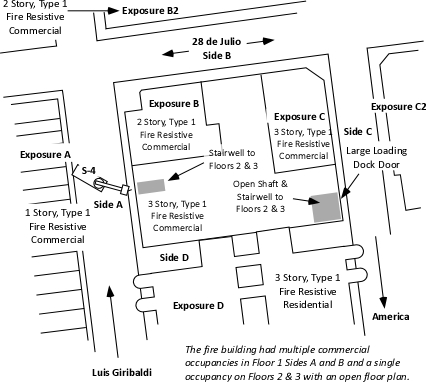
Figure 1. Plot Plan
Floors 2 and 3 had an open floor plan and were used for storage of a large amount of fabric and other materials. As illustrated in Figure 1, there were two means of access to Floors 2 and 3; a stairway on Side A and an open shaft and stairway on Side C.
Due to heavy fire involvement, operations focused on a predominantly defensive strategy to control the fire in this multi-occupancy commercial building. The incident commander called for a second, and then third alarm. Defensive operations involved use of handlines and an aerial ladder working from Side A and in the Side A stairwell leading to Floor 2. However, application of water from the ladder pipe had limited effect (possibly because of the depth of the building and burning contents shielded from direct application from the elevated stream.
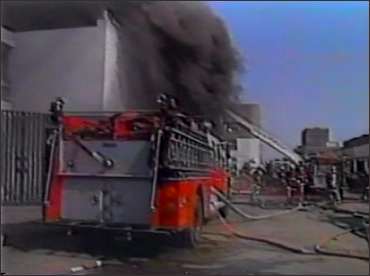
Figure 2. Early Defensive Operations
Note: Video screen shot from the intersection of Luis Giribaldi and 28 de Julio.
The third alarm at 14:05 hours brought two engines and articulating boom aerial platform (Snorkel) from Lima 4 to the incident. Snorkel 4, under the command of Captain Roberto Reyna was tasked to replace the aerial ladder which had been operating on Side A and operate an elevated master stream to control the fire on Floor 2 (Figure 2).
Placing their master stream into operation Teniente Oscar Ruiz and Captain Roberto Reyna worked to darken the fire on Floor 2. As exterior streams were having limited effect, Snorkel 4 was ordered to discontinue operation and began to lower the bucket to the ground. At the same time, efforts were underway to gain access to the building from Side C. Using forcible entry tools, firefighters breached the large loading dock door leading to the vertical shaft and stairwell in the C/D quadrant of the building.
Prior to opening the large loading dock door on Side C (Charlie/Delta Corner), a predominantly bi-directional air track is visible at ventilation openings on Side C. Flaming combustion from windows on Side A was likely limited to the area at openings with a bidirectional air track. Combustion at openings on Side A likely consumed the available atmospheric oxygen, maintaining extremely ventilation controlled conditions with a high concentration of gas phase fuel from pyrolyzing synthetic fabrics deeper in the building.
The ventilation profile when Snorkel 4 initially began operations included intake of air through the open interior stairwell (inward air track) serving floors 1-3 and from the lower area of windows which were also serving as exhaust openings (bi-directional air track). Interview of members operating at the incident indicates that there were few if any ventilation openings (inlet or exhaust) on Sides B, C, or D prior to creation of an access opening on Floor 1 Side C.
At approximately 15:50, Snorkel 4 was ordered to stop flowing water. As smoke conditions worsened, they did so and began to lower the aerial tower to the ground. At the same time, crews working to gain access to Floor 1 on Side C, breached the large loading dock door. A strong air track developed, with air rushing in the large opening and up the open vertical shaft leading to the upper floors as illustrated in Figure 3.
Figure 3. Layout of Floors 1 and 2
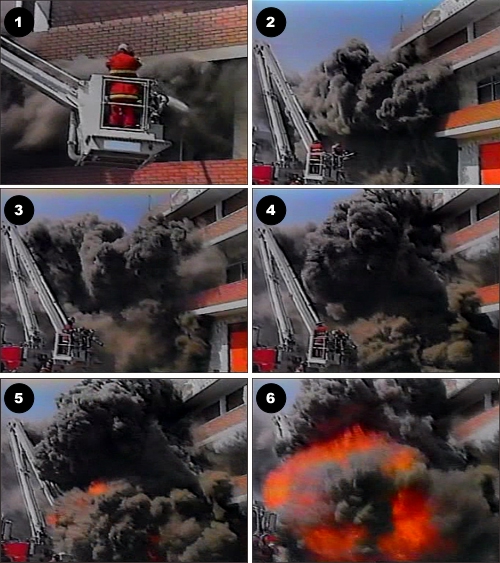
As the Snorkel was lowered to the ground, Teniente Oscar Ruiz observed a change in smoke conditions, observing a color change from gray/black to “phosphorescent yellow” (yellowish smoke can also be observed in the video clip of this incident). Less than two minutes after the change in ventilation profile, a violent backdraft occurred, producing a large fireball that engulfed Captain Roberto Reyna and Teniente Oscar Ruiz in Snorkel 4 (see Figure 4). The blast seriously injured the crew of Snorkel 4 along with numerous other members from stations Lima 4, Salvadora Lima 10, and Victoria 8 who were located in the Stairwell (these members were blown from the building) and on the exterior of Side A.
This incident eventually progressed to a fifth alarm with 63 companies from 26 of Lima’s 58 stations in attendance.
Figure 4. Backdraft Sequence
Watch the video again; keeping in mind the changes in air track that resulted from breaching the loading dock door on Side C. Consider the B-SAHF (Building, Smoke, Air Track, Heat, and Flame) indicators that are present as the video progresses.
Luis Giribaldi Street and 28 de Julio Street Today
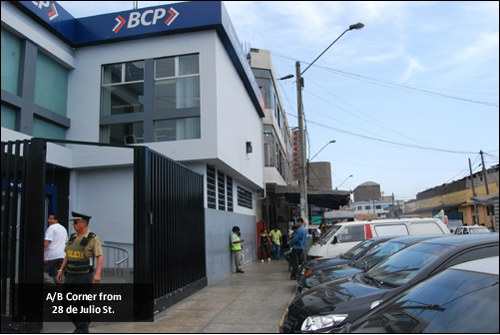
The building involved in this incident is still standing and while it has been renovated, is much the same as it was in 1997. On December 6, 2010, Teniente Brigadier Giancarlo Passalaqua, myself and Capitáin Jordano Martinez went to Luis Giribaldi and 28 de Julio to walk the ground and gain some insight into this significant incident.
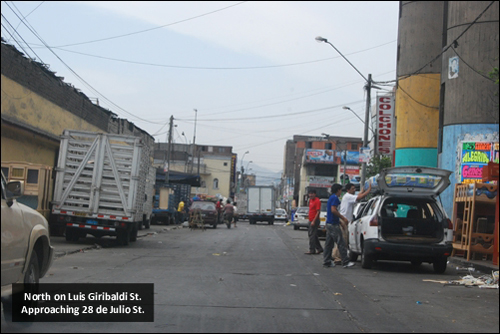
Figure 5. Luis Giribaldi Street
As illustrated in Figure 5, Luis Giribaldi Street is a one-way street with parking on both sides and overhead electrical utility lines.
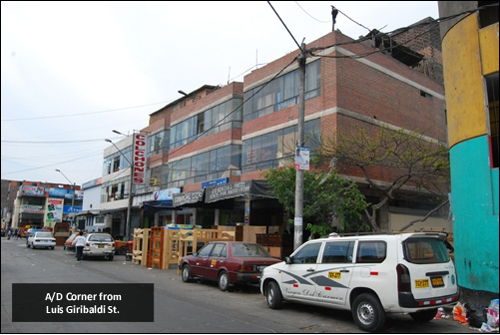
Figure 6. A/D Corner
There are a number of obvious structural changes that have been made since the fire. Including installation of window glazing flush with the surface of the building (the original windows can be seen behind these outer windows).
Figure 7. Snorkel 4’s Position
Figure 7 shows the view from Snorkel 4’s position, just to the left of center is the entry way leading to the stairwell used to access Floors 2 and 3. Piled fabric and other materials can be seen through the windows of Floors 2 and 3, likely similar in nature to conditions at the time of the incident.
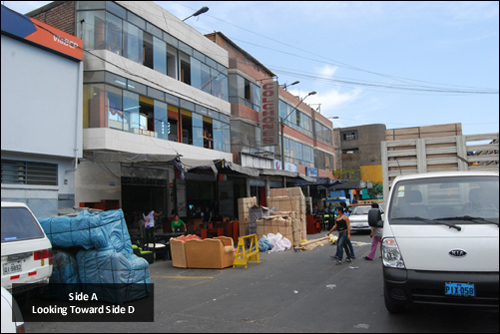
Figure 8. Side A
Figure 8 provides a view of Side A and Exposure B, which appears to be of newer construction and having a different roofline than the fire building. The appearance of the left and right sides of the fire building are different, but this is simply due to differences in masonry veneer on the exterior of the building.
Figure 9. A/B Corner
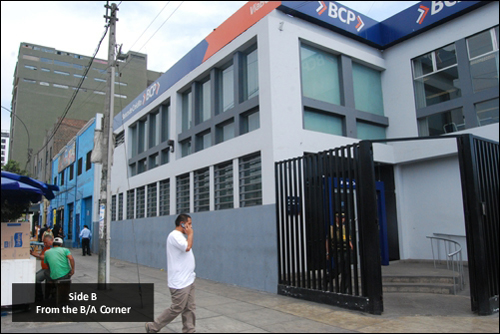
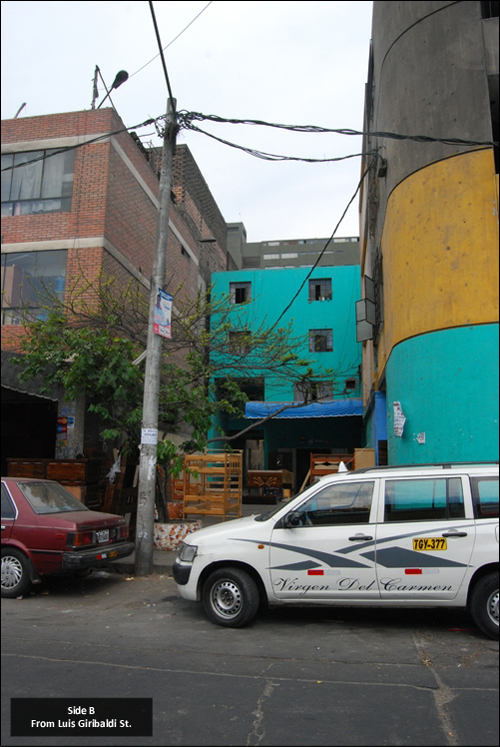
Figure 10. Side B
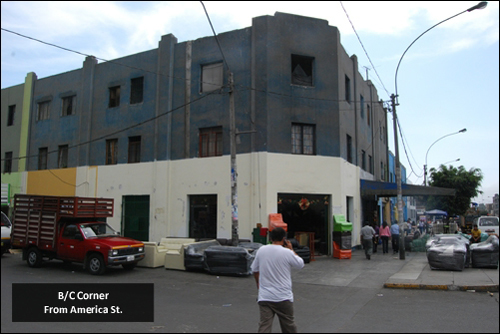
Figure 11. B/C Corner
As illustrated in Figures 10-11 this block is comprised of several attached, fire resistive buildings. It is difficult to determine the interior layout from the exterior as there are numerous openings in interior walls due to renovations and changes in occupancy over time. The floor plan illustrated in Figure 4 is the best estimate of conditions at the time of the fire based on interviews with members operating at the incident.
Figure 12. Side C and the Loading Dock Door
Figure 12shows Side C of the fire building and Exposure C and the loading dock door that was breached to provide access to the fire building from Side C immediately prior to the backdraft.
Figure 13. Side D and Exposure D
Figure 13illustrates the proximity of Exposure D, a three-story, fire-resistive apartment building.
Lessons Learned
This incident presented a number of challenges including a substantial fuel load (in terms of both mass and heat of combustion), fuel geometry (e.g., piled stock), and configuration (e.g., shielded fire, difficult access form Side C). Analysis of data from the short video clip and discussion of this incident with those involved provides a number of important lessons.
Knowledge of the buildings in your response area is critical to safe and effective firefighting operations. While a challenging task, particularly in a large city such as Lima, developing familiarity with common building types and configurations and pre-planning target hazards can provide a significant fireground advantage.
Reading the fire is essential to both initial size-up and ongoing assessment of conditions. In this incident, fire behavior indicators may have provided important cues needed to avoid the injuries that resulted from this extreme fire behavior event.
Some fire behavior indicators can be observed from one position, while others may not. It is particularly important that individuals in supervisory positions be able to integrate observations from multiple perspectives when anticipating potential changes in fire behavior.
Any opening, whether created for tactical ventilation or for entry has the potential to change the ventilation profile. It is important to consider potential changes in fire behavior that may result from changes in ventilation (particularly when the fire is ventilation controlled).
Communication and coordination are critical during all fireground operations. It is essential to communicate observations of key fire behavior indicators and changes in conditions to Command. Tactical ventilation (or other tactical operations that may influence fire behavior) must be coordinated with fire attack.
Protective clothing and self-contained breathing apparatus are a critical last line of defense when faced with extreme fire behavior (even when engaged in exterior, defensive operations).
I would like to recognize the members of the Peruvian fire service who assisted in my efforts to gather information about this incident and identify the important lessons learned. In particular, I would like to thank Teniente Brigadier Giancarlo Passalaqua, Brigadier CBP Oscar Ruiz, and my brothers at Lima 4 who generously shared their home, their time, and their knowledge.
Ed Hartin, MS, EFO, MIFIreE, CFO
When I was invited to Lima, I asked my friend Teniente Brigadier CBP Giancarlo Passalaqua who worked at this incident, if it would be possible to talk to other firefighters who were there and to walk the ground around the building to gain additional insight into this incident.
This post continues examination of the incident that took the life of Firefighter Brian Carey and seriously injured Firefighter Kara Kopas on the evening of March 30, 2010 while they were operating a hoseline in support of primary search in a small, one-story, wood frame dwelling with an attached garage at 17622 Lincoln Avenue in Homewood, Illinois.
This post focuses on firefighting operations, key fire behavior indicators, and firefighter rescue operations implemented after rapid fire progression that trapped Firefighters Carey and Kopas.
Firefighting Operations
After making initial assignments, the Incident Commander performed reconnaissance along Side Bravo to assess fire conditions. Fire conditions at around the time the Incident Commander performed this reconnaissance are illustrated in Figure 7. After completing recon of Side B, the Incident Commander returned to a fixed command position in the cab of E-534 (in order to monitor multiple radio frequencies).
Figure 7. Conditions Viewed from Side C during the Incident Commander’s Recon
Note: John Ratko Photo from NIOSH Death in theLine of Duty Report F2010-10.
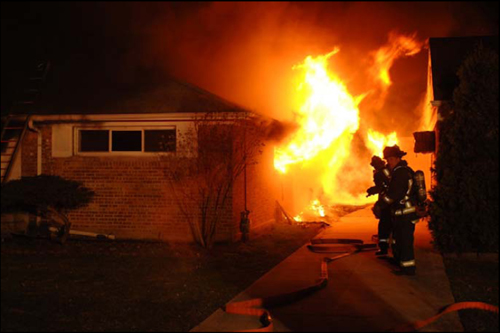
Engine 1340 (E-1340) arrived and reported to Command for assignment. The five member crew of this company was split to assist T-1220 with vertical ventilation, horizontally ventilate through windows on Sides B and D, and to protect Exposures D and D2.
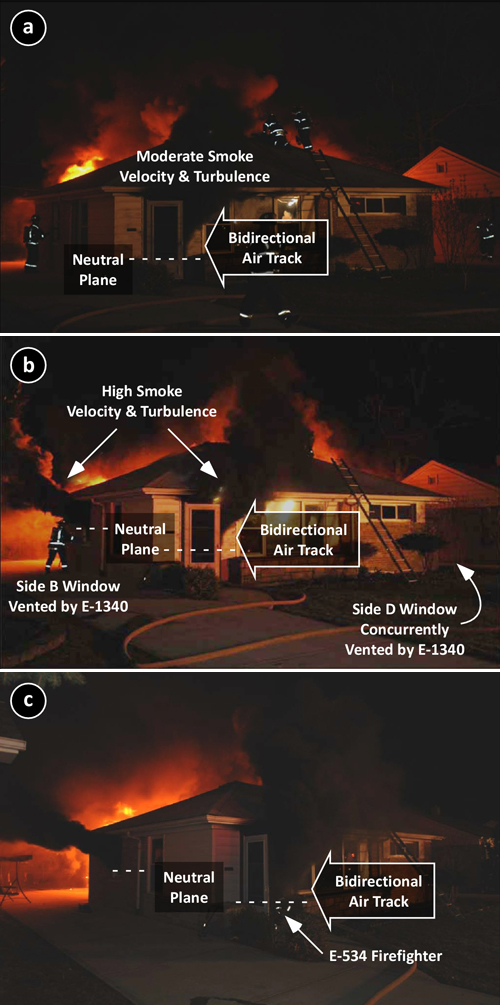
One member of E-1340 assisted T-1220 and the remaining members vented the kitchen windows on SidesD and B, while the E-1340 Officer stretched a 1-3/4” (45 mm) hoseline from E-534 to protect exposures on Side D. However, this line was not charged until signficantly later in the incident (see Figure 14). Figure 8 (a-c) illustrates changing conditions as horizontal ventilation is completed on Sides B and D.
Figure 8. Sequence of Changing Conditions Viewed from the A/B Corner
At 2105 Command reported that crews were conducting primary search and were beginning to vent.
Note the B-SAHF indicators visible from the A/B Corner in Figure 8a: Dark gray smoke from the door on Side A with the neutral plane at approximately 18” (0.25 m) above the floor. Velocity and turbulence are moderate and a bidirectional air track is evident at the doorway.
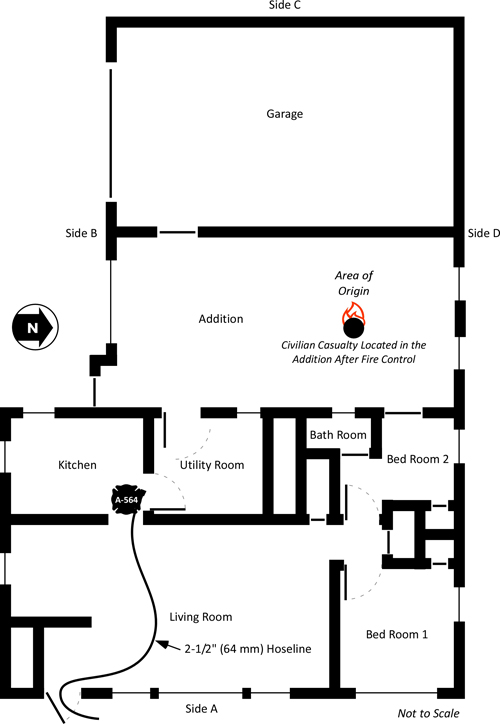
As the 2-1/2” (64 mm) handline reached the kitchen, flames were beginning to breach the openings in the Side C wall of the house and thick black smoke had banked down almost to floor level. As noted in Figure 3 (and subsequent floor plan illustrations), there were doors and windows between the house and addition in the Utility Room and Bedroom 2 . The Firefighter from E-534 had a problem with his protective hood and handed the nozzle off to Firefighter Carey and instructed him to open and close the bail of the nozzle quickly. After doing so, the Firefighter from E-534 retreated along the hoseline to the door on Side A to correct this problem (heis visible in the doorway in Figure 8c).
As E-1340 vents windows on Sides B (see Figure 8b) and D, the level of the neutral plane at the doorway on Side A lifts, but velocity and turbulence of smoke discharge increases. Work continues on establishing a vertical vent, but is hampered by smoke discharge from the door on Side A.
After horizontal ventilation of Sides B and D, velocity and turbulence of smoke discharge continues to increase and level of the upper layer drops to the floor as evidenced by the neutral plane at the door on Side A (see Figures 8b and 8c)
The photo in Figure 8c was taken just prior to the rapid fire progression that trapped Firefighters Carey & Kopas. The Firefighter from E-534 is visible in the doorway correcting a malfunction with his protective hood.
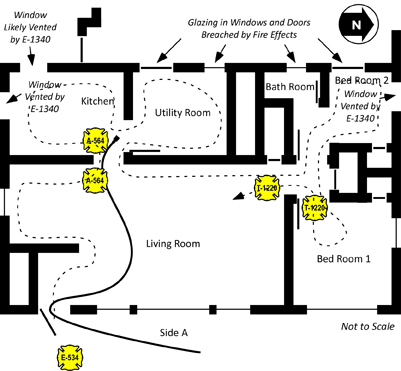
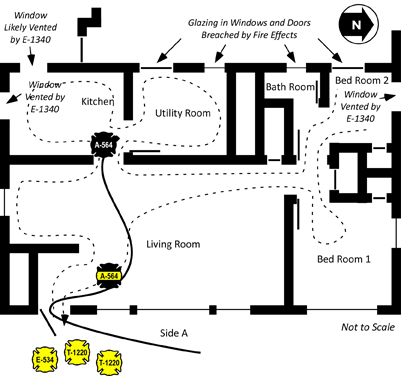
As T-1220B reached the hallway leading to the bedrroms, they felt a significant increase in temperature and visibility worsened. After searching Bedroom 2 and entering Bedroom 1 temperature contiued to increase and T-1220B observed flames rolling through the upper layer in the hallway leading from Bedroom 2 and the Bathroom. Note: NIOSH Death in the Line of Duty Report 2010-10 does not specify if T-1220B searched Bedroom 2, but this would be consistent with a left hand search pattern. They immedidately retreated to the Living Room looking for the hoseline leading to the door on Side A. As they did so, they yelled to the crew on the 2-1/2” (64 mm) handline to get out.
Extreme Fire Behavior
Firefighter Kopas felt a rapid increase in temperature as the upper layer ignited throughout the living room and the fire in this compartment transitioned to a fully developed stage. She yelled to Firefighter Carey, but received no response as she turned to follow the 2-1/2” (64 mm) hoseline back to the door on Side A. She made it to within approximately 4’ (1.2 m) of the front door when her protective clothing began to stick to melted carpet and she became stuck. T-1220B saw that she was trapped, reentered and pulled her out.
Figure 12. Position of the Crews as the Extreme Fire Behavior Phenomena Occurred
Note: It is unknown if T-1220B searched Bedroom 2 before entering Bedroom 1. However, this would be consistent with a left hand search pattern.
Figure 13. Conditions Viewed from the Alpha/Bravo Corner as the Extreme Fire Behavior Occured
Note: Warren Skalski Photo from NIOSH Death in theLine of Duty Report F2010-10.
Figure 14. Conditions Viewed from the Alpha/Delta Corner as the Extreme Fire Behavior Occured
Note: Warren Skalski Photo from NIOSH Death in theLine of Duty Report F2010-10.
Following the transition to fully developed fire conditions in the living room, the Incident Commander ordered T-1220 off the roof. As illustrated in Figure 14, the exposure protection line stretched by E-1340 was not charged until after Firefighter Carey was removed from the building.
Figure 15. Position of Search and Fire Control Crews after Rapid Fire Progress
Firefighter Rescue Operations
The Incident Commander and Firefighter from E-534 (who had retreated to the door due to a problem with his protective hood), pulled a second 1-3/4” (45 mm) line from E-534. T-1220B re-entered the house with this hoseline to locate Firefighter Carey.
While advancing into the living room, T-1220B discovered that E-534’s 2-1/2” (64 mm) handline. They controlled the fire in the living room using a direct attack on burning contents and advanced to the kitchen where they discovered Firefighter Carey entangled in the 2-1/2” (64 mm) handline. Firefighter Carey’s helmet and breathing apparatus facepiece were not in place.
T-1220B removed Firefighter Carey from the building where he received medical care from T-1145. A short time later, Firefighter Carey became apenic and pulseless. After the arrival of Ambulance 2101 (A-2101), Firefighter Carey was transported to Advocate South Suburban Hospital in Hazel Crest, IL where he was declared dead at 10:03 pm.
According to the autopsy report, Firefighter Carey had a carboxyhemoglobin (COHb) of 30% died from carbon monoxide poisoning. The NIOSH Death in the Line of Duty Report (2010) did not indicate if the medical examiner tested for the presence of hydrogen cyanide (HCN) or if thermal injuries were a contributing factor to Firefighter Carey’s death.
Timeline
Review the Homewood, Illinois Timeline (PDF format) to gain perspective of sequence and the relationship between tactical operations and fire behavior.
Contributing Factors
Firefighter injuries often result from a number of causal and contributing factors. NIOSH Report F2010-10 identified the following contributing factors in this incident that led to the death of Firefighter Brian Carey and serious injuries to Firefighter Kara Kopas.
Well involved fire with trapped civilian upon arrival.
Incomplete 360o situational size-up
Inadequate risk-versus-gain analysis
Ineffective fire control tactics
Failure to recognize, understand, and react to deteriorating conditions
Uncoordinated ventilation and its effect on fire behavior
Removal of self-contained breathing apparatus (SCBA) facepiece
Inadequate command, control, and accountability
Insufficient staffing
Questions
The following questions focus on fire behavior, influence of tactical operations, and related factors involved in this incident.
What type of extreme fire behavior phenomena occurred in this incident? Why do you think that this is the case (justify your answer)?
How did the conditions necessary for this extreme fire behavior event develop (address both the fuel and ventilation sides of the equation)?
What fire behavior indicators were present in the eight minutes between arrival of the first units and occurrence of the extreme fire behavior phenomena (organize your answer using Building, Smoke, Air Track, Heat, and Flame (B-SAHF) categories)? In particular, what changes in fire behavior indicators would have provided warning of impending rapid fire progression?
Did any of these indicators point to the potential for extreme fire behavior? If so, how? If not, how could the firefighters and officers operating at this incident have anticipated this potential?
What was the initiating event(s) that lead to the occurrence of the extreme fire behavior that killed Firefighter Carey and injured Firefighter Kopas?
How did building design and construction impact on fire behavior and tactical operations during this incident?
What action could have been taken to reduce the potential for extreme fire behavior and maintain tenable conditions during primary search operations?
How would you change, expand, or refine the list of contributing factors identified by the NIOSH investigators?
While formal learning is an essential part of firefighters’ and fire officers’ professional development, informal learning is equally important, with lessons frequently shared through the use of stores. Stories are about sharing knowledge, not simply about entertainment. It is their ability to share culture, values, vision and ideas that make them so critical. They can be one of the most powerful learning tools available (Ives, 2004). “Only by wrestling with the conditions of the problem at hand and finding his own way out, does [the student] think” (Dewey, 1910, p. 188).
Developing mastery of the craft of firefighting requires experience. However, it is unlikely that we will develop the base of knowledge required simply by responding to incidents. Case studies provide an effective means to build our knowledge base using incidents experienced by others. This case is particularly significant as the circumstances could be encountered by almost any firefighter.
Aim
Firefighters and fire officers recognize and respond appropriately to the hazards of ventilation controlled fires in small, Type V (wood frame), single family dwellings.
References
National Institute for Occupationsl Safey and Health (NIOSH). (2010). Death in the line of duty: Report F2010-10. Retrieved October 22, 2010 from http://www.cdc.gov/niosh/fire/pdfs/face201010.pdf.
Ives, B. (2004) Storytelling and Knowledge Management: Part 2 – The Power of Stories. Retrieved May 6, 2010 from http://billives.typepad.com/portals_and_km/2004/08/storytelling_an_1.html
Dewey, J. (1910) Democracy and education. New York: McMillan
Learning Activity
Review the incident information and discuss the questions provided. Focus your efforts on understanding the interrelated impact of ventilation and fire control tactics on fire behavior. Even more important than understanding what happened in this incident is the ability to apply this knowledge in your own tactical decision-making.
On the evening of March 30, 2010, while operating at a fire in a small single family dwelling, Firefighter/Paramedic Brian Carey and Firefighter/Paramedic Kara Kopas were assigned to assist in advancement of a 2-1/2” handline for offensive fire attack and to support primary search. Shortly after entering the building conditions deteriorated and they were trapped by rapid fire progression. Firefighter Kopas suffered 2nd and 3rd degree burns to her lower back, buttocks, and right wrist. Firefighter Carey died from carbon monoxide poisoning and inhalation of smoke and soot. A 84 year old male civilian occupant also perished in the fire.
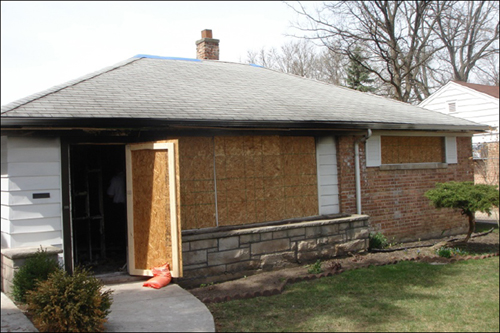
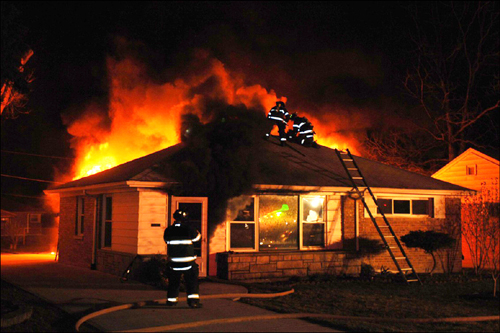
Figure 1. Side A Post Fire
Note: National Institute for Occupational Safety and Health (NIOSH)
Building Information
This incident involved a 950 ft2 (88.26 m2), one-story, single family dwelling constructed in 1951. The house was of Type V (wood frame) construction with a hip roof covered with asphalt shingles. The roofline of the hip roof provided a small attic space. Sometime after the home was originally constructed an addition C was built that attached the house to a garage located on Side C. Compartment linings were drywall. The house, garage, and addition were all constructed on a concrete slab.
There were several openings between the house and addition, including two doors, and two windows (see Figure 3).
Note: The number and nature of openings between the garage and addition is not reported, but likely included a door and possibly a window (given typical garage construction). NIOSH investigators did not determine if the doors and windows between the house, addition, and garage were open or closed at the time of the fire as they were consumed by the fire and NIOSH did not interview the surviving occupant (S. Wertman, personal communication, November 17, 2010). The existence and position of the door shown in the wall between the addition and garage is speculative (based on typical design features of this type of structure).
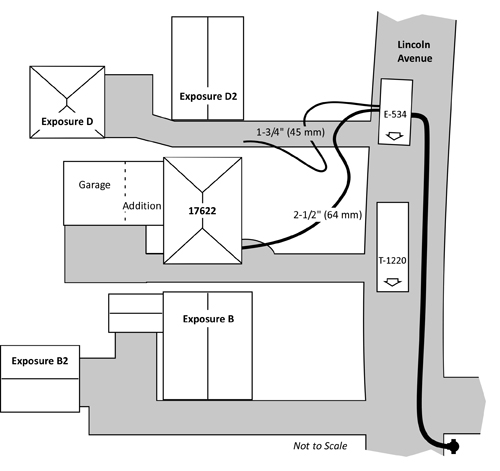
Figure 2. Plot Plan and Apparatus Positioning
Figure 3. Floor Plan 17622 Lincoln Avenue
The Fire
Investigators believe that the fire originated in an addition that was constructed between the original home and the two-car garage. The surviving occupant reported that she observed black smoke and flames from underneath the chair that her disabled husband was sitting in.
The addition was furnished as a family room and fuel packages included upholstered furniture and polyurethane padding. The civilian victim also had three medical oxygen bottles (one D Cylinder (425 L) and two M-Cylinders (34 L). It is not know if the oxygen in these cylinders was a factor in fire development. The garage contained a single motor vehicle in the garage and other combustible materials.
After calling 911 and attempting to extinguish the fire, the female occupant exited the building. NIOSH Death in the Line of Duty Report 2010-10 did not specify this occupants egress path or if she left the door through which she exited open or closed (NIOSH did not interview the occupant, she was interviewed by local fire and law enforcement authorities). The NIOSH investigator (personal communications S. Wertman, November 17, 2010) indicated that the occupant likely exited through the exterior door in the addition or through the door on Side A. Give rapid development through flashover in the addition, it is likely that the exterior door in the addition or door to the garage was open, pointing to the likelihood that the occupant exited through this door. Subsequent rapid extension to the garage was likely based on design features of the addition and garage or some type of opening between these two compartments. As similar extension did not occur in the house, it is likely that the door and windows in the Side C wall of the house were closed.
In the four minutes between when the incident was reported (20:55 hours) and arrival of a law enforcement unit (20:59), the fire in the addition had progressed from the incipient stage to fully developed fire conditions in both the addition and garage.
Dispatch Information
At 2055 hours on March 30, 2010, dispatch received a call from a resident at 17622 Lincoln Avenue stating that her paralyzed husband’s chair was on fire and that he was on oxygen. The first alarm assignment consisting of two engines, two trucks, a squad, and ambulance, and fire chief was dispatched at 2057.
Table 1. On-Duty and Additional Unit Staffing of First Alarm Resources
The weather was clear with a temperature of 12o C (53o F). Firefighters operating at the incident stated that wind was not a factor.
Conditions on Arrival
A law enforcement officer arrived prior to fire companies and reported that the house was “fully engulfed” and that the subject in the chair was still in the house.
Truck 1220 (T-1220) arrived at 2101, observed that the fire involved a single family dwelling, and received verbal reports from law enforcement and bystanders that the male occupant was still inside. Note: The disabled male occupant’s last known location was in the addition between the house and garage, but it is unknown if this information was clearly communicated to T-1220 or to Command (E-534 Lieutenant).
Engine 534 (E-534) arrived just behind T-1220 and reported heavy fire showing. E-534 had observed flames from Side C during their response and discussed use of a 2-1/2” (64 mm) handline for initial attack.
Firefighting Operations
Based on the report of a trapped occupant, T-1220B (Firefighter and Apparatus Operator) prepared to gain entry and conduct primary search. Note: Based on data in NIOSH Death in the Line of Duty Report 2010-10, it is not clear that this task was assigned by the initial Incident Commander (Engine 534 Lieutenant). It appears that this assignment may have been made by the T-1220 Lieutenant, or performed simply as a default truck company assignment for offensive operations at a residential fire.
Upon arrival, the E-534 Lieutenant assumed Command and transmitted a size-up report indicating heavy fire showing. The Incident Commander(E-534 Lieutenant) assisted the E-534 Firefighter with removal of the 1-3/4” (45 mm) skid load from the solid stream nozzle on the 2-1/2” (64 mm) hose load and stretching the 2-1/2” (64 mm) handline to the door on Side A. The E-534 Apparatus Operator charged the line with water from the apparatus tank and then hand stretched a 5” supply line to the hydrant at the corner of Lincoln Avenue and Hawthorne Road with the assistance of a Firefighter from T-1220.
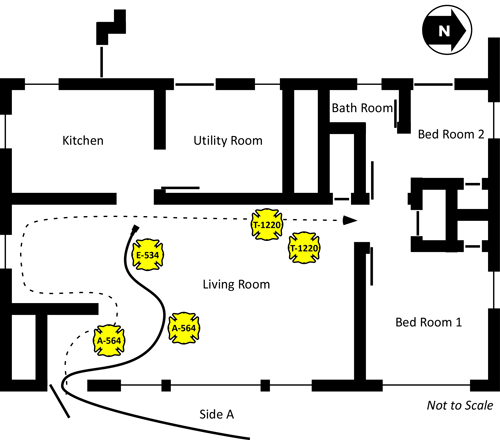
Figure 4. Initiation of Primary Search
The Incident Commander (E-534 Lieutenant) assisted T-1220B in forcing the door on Side A. T-1220B made entry without a hoseline and began a left hand search as illustrated in Figure 4, noting that the upper layer was banked down to within approximately 3’ (0.9 m) from the floor).
Arriving immediately after E-534, the crew of A-564 donned their personal protective equipment and reported to the Incident Commander at the door on Side A, where he and the E-534 Firefighter were preparing to make entry with the 2-1/2” hoseline. The Incident Commander then assigned A-564 to work with the E-534 Firefighter to support search operations and control the fire.
T-1220 initiated roof operations and began to cut a ventilation opening on Side A near the center of the roof. Note: Based on data in NIOSH Death in the Line of Duty Report 2010-10, it is not clear that this task was assigned by the initial Incident Commander (Engine 534 Lieutenant). It appears that this assignment may have been made by the T-1220 Lieutenant, or performed simply as a default truck company assignment for offensive operations at a residential fire.
As illustrated in Figure 5, a large body of fire can be observed on Side C and a bi-directional air track is evident at the point of entry on Side A with dark gray smoke pushing from the upper level of the doorway at moderate velocity. All windows on Sides A and B were intact, with evidence of soot and/or condensed pyrolizate on the large picture window adjacent to the door on Side A.
Figure 5. Conditions Viewed from the Alpha/Bravo Corner at Approximately
Note: Warren Skalski Photo from NIOSH Death in theLine of Duty Report F2010-10.
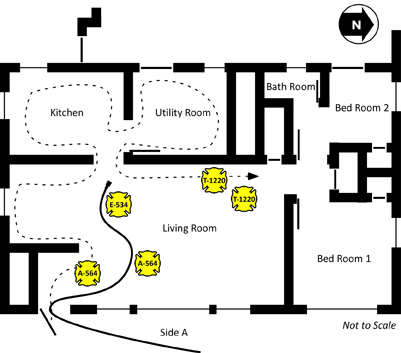
The Firefighter from E-534 took the nozzle and assisted by Firefighters Carey and Kopas (A-564) stretched the 2-1/2” (64 mm) handline through the door on Side A and advanced approximately 12’ (3.66 m) into the kitchen. As they advanced the hoseline, they were passed by T-1220B, conducting primary search. The E-534 Firefighter, Firefighter Kopas (A-564), and T-1220B observed thick (optically dense), black smoke had dropped closer to the floor and that the temperature at floor level was increasing.
Figure 6. Primary Search and Fire Control Crews
Questions
Take a few minutes and consider the answers to the following questions. Remember that it is much easier to sort through the information presented by the incident when you are reading a blog post, than when confronted with a developing fire with persons reported!
What B-SAHF (Building, Smoke, Air Track, Heat, & Flame) indicators were observed during the initial stages of this incident?
What stage(s) of fire and burning regime(s) were present in the building when T-1220 and E-534 arrived? Consider potential differences in conditions in the addition, garage, kitchen, bedrooms, and living room?
What would you anticipate as the likely progression of fire development over the next several minutes? Why?
How might tactical operations (positively or negatively) influence fire development?
Ed Hartin, MS, EFO, MIFireE, CFO
Note: The number and nature of openings between the garage and addition is not reported, but likely included a door and possibly a window (given typical garage construction). NIOSH investigators did not determine if the doors and windows between the house, addition, and garage were open or closed at the time of the fire as they were consumed by the fire and NIOSH did not interview the surviving occupant (S. Wertman, personal communication, November 17, 2010). The existence and position of the door shown in the wall between the addition and garage is speculative (based on typical design features of this type of structure).
My last post, Hazards Above, provided a brief overview of three incidents involving extreme fire behavior in the attic or truss loft void spaces of wood frame dwellings. This post will examine the similarities and differences between these lessons and identify several important considerations when dealing with fires occurring in or extending to void spaces. At the conclusion of Hazards Above, I posed five questions:
What is similar about these incidents and what is different?
Based on the limited information currently available, what phenomena do you think occurred in each of the cases? What leads you to this conclusion?
What indicators might have pointed to the potential for extreme fire behavior in each of these incidents?
How might building construction have influenced fire dynamics and potential for extreme fire behavior in these incidents?
What hazards are presented by fires in attics/truss lofts and what tactics may be safe and effective to mitigate those hazards?
Similarities and Differences
The most obvious similarities between these incidents was that the buildings were of wood frame construction, the fire involved or extended to an attic or truss loft void space, and that some type of extreme fire behavior occurred. In two of the incidents firefighters were seriously injured, while in the other firefighters escaped unharmed.
Given the limited information available from news reports and photos taken after the occurrence of the extreme fire behavior events, it is not possible to definitively identify what types of phenomena were involved in these three incidents. However, it is interesting to speculate and consider what conditions and phenomena could have been involved. It might be useful to examine each of these incidents individually and then to return to examine fire behavior indicators, construction, and hazards presented by these types of incidents.
Minneapolis, MN
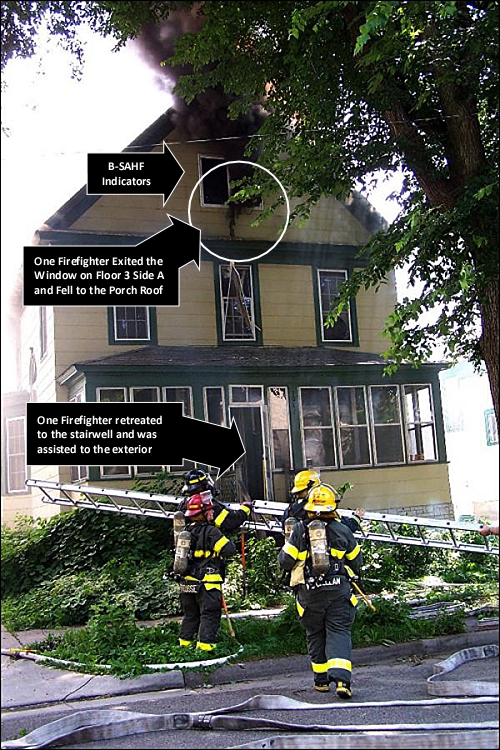
In the Minneapolis incident the fire occurred in an older home with legacy construction and relatively small void spaces behind the knee walls and above the ceiling on Floor 3. The triggering event for the occurrence of extreme fire behavior is reported to be opening one of the knee walls on Floor 3. As illustrated in Figure 1, the fire appeared to transition quickly to a growth stage fire (evidenced by the dark smoke and bi-directional air track from the windows on Floor 3 Side A. However blast effects on the structure are not visible in the photo and were not reported.
Figure 1. Minneapolis MN Incident: Conditions on Side A
Note: Photo by Steve Skar
Potential Influencing Factors: While detail on this specific incident is limited, it is likely that the fire burning behind the knee wall was ventilation controlled and increased ventilation resulting from opening the void space resulted in an increase in heat release rate (HRR). Potential exists for any compartment fire that progresses beyond the incipient stage to become ventilation controlled. This is particularly true when the fire is burning in a void space.
Extreme Fire Behavior: While statements by the fire department indicate that opening the knee wall resulted in occurrence of flashover, this is only one possibility. As discussed in The Hazard of Ventilation Controlled Fires and Fuel and Ventilation, increasing ventilation to a ventilation controlled fire will result in increased HRR. Increased HRR can result in a backdraft (if sufficient concentration of gas phase fuel is present), a vent induced flashover, or simply fire gas ignition (such as rollover or a flash fire) without transition to a fully developed fire.
Harrisonburg, VA
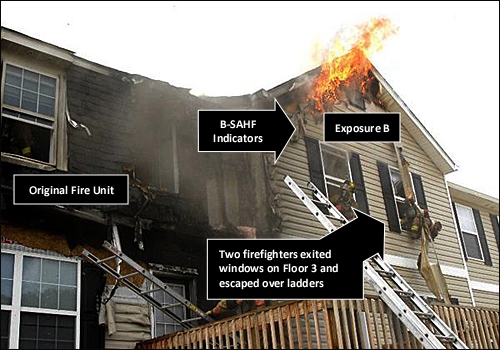
The Harrisonburg incident involved extreme fire behavior in Exposure D (not the original fire unit). The extreme fire behavior occurred after members had opened the ceiling to check for extension. However, this may or may not have been the precipitating event. As illustrated in Figure 2, as members prepare to exit from the windows on Floor 3 , Side C, flames are visible on the exterior at the gable, but it appears that combustion is limited to the vinyl siding and soffit covering. There are no indicators of a significant fire in Exposure D at the time that the photo was taken. However, it is important to remember that this is a snapshot of conditions at one point in time from a single perspective.
Figure 2. Harrisonburg, VA Incident: Conditions on Side C
Note: Photo by Allen Litten
Potential Influencing Factors: The truss loft was likely divided between units by a 1 hour fire separation (generally constructed of gypsum board over the wood trusses). While providing a limited barrier to fire and smoke spread, it does not generally provide a complete barrier and smoke infiltration is likely. Sufficient smoke accumulation remote from the original fire location can present risk of a smoke explosion (see NIOSH Report 98-03 regarding a smoke explosion in Durango, Colorado restaurant). Alternately, fire extension into the truss loft above an exposure unit can result in ventilation controlled fire conditions, resulting in increased HRR if the void is opened (from above or below).
Extreme Fire Behavior: Smoke, air track, and flame indicators on Side C indicate that the fire in the truss loft may not have continued to develop past the initial ignition of accumulated smoke (fuel). It is possible that smoke accumulated in the truss loft above Exposure B and was ignited by subsequent extension from the fire unit. Depending on the fuel (smoke)/air mixture when flames extended into the space above Exposure B ignition could have resulted in a smoke explosion or a less violent fire gas ignition such as a flash fire.
Sandwich, MA
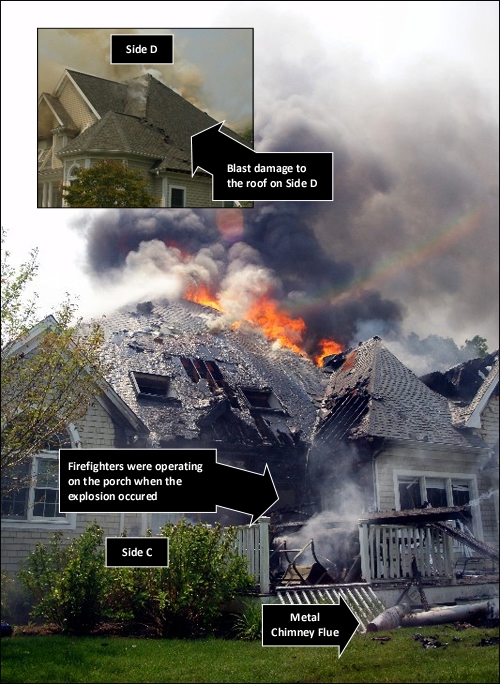
In the Sandwich incident, the extreme fire behavior occurred shortly after the hose team applied water to the soffit. However, this may or may not have been the precipitating event. As illustrated in Figure 3, the fire transitioned to a fully developed fire (likely due to the delay in suppression as the injured members were cared for). Blast effects on the structure are obvious.
Figure 3: Sandwich, MA: Conditions on Sides C and D
Potential Influencing Factors: The roof support system in this home appears to have been constructed of larger dimensional lumber (rather than lightweight truss construction). In addition, it is likely that the attic void spaces involved in this incident were large and complex (given the size of the dwelling and complex roof line). It appears that at least part of the home had a cathedral ceiling. Fire burning in the wood framing around the metal chimney would have allowed smoke (fuel) and hot gases to collect in the attic void in advance of fire extension.
Extreme Fire Behavior: The violence of the explosion (see blast damage to the roof on Side D in Figure 3) points to the potential for ignition of pre-mixed fuel (smoke) and air, resulting in a smoke explosion. However, it is also possible that failure of an interior ceiling (due to water or steam production from water applied through the soffit) could have increased ventilation to a ventilation controlled fire burning in the attic, resulting in a backdraft).
Fire Behavior Indicators
The information provided in news reports points to limited indication of potential for extreme fire behavior. One important question for each of us is how we can recognize this potential, even when indicators are subtle or even absent.
Important! A growth stage fire can present significant smoke and air track indicators, with increasing thickness (optical density), darkening color, and increasing velocity of smoke discharge. However, as discussed in The Hazard of Ventilation Controlled Fires, when the fire becomes ventilation controlled, indicators can diminish to the point where the fire appears to be in the incipient stage. This change in smoke and air track indicators was consistently observed during the full-scale fire tests of the influence of ventilation on fires in single-family homes conducted by UL earlier this year.
Even with an opening into another compartment or to the exterior of the building, a compartment fire can become ventilation controlled. Consider building factors including potential for fire and smoke extension into void spaces in assessing fire conditions and potential for extreme fire behavior. A ventilation controlled fire or flammable mixture of smoke and air may be present in a void space with limited indication from the exterior or even when working inside the structure.
Building Construction
Each of these incidents occurred in a wood frame structure. However, the construction in each case was somewhat different.
In Minneapolis, the house was likely balloon frame construction with full dimension lumber. As with many other structures with a “half-story”, the space under the pitched roof is framed out with knee walls to provide finished space. This design is not unique to legacy construction and may also be found with room-in-attic trusses. The void space behind the knee wall provides a significant avenue for fire spread. When involved in fire, opening this void space can quickly change fire conditions on the top floor as air reaches the (likely ventilation controlled) fire.
The incident in Harrisonburg involved a fire in a townhouse with the extreme fire behavior phenomena occurring in an exposure. While not reported, it is extremely likely that the roof support system was comprised of lightweight wood trusses. In addition, there was a reverse gable (possibly on Sides A and C) that provided an additional void. As previously indicated, the truss loft between dwelling units is typically separated by a one-hour rated draft stop. Unlike a fire wall, draft stops do not penetrate the roof and may be compromised by penetrations (after final, pre-occupancy inspection). Installed to code, draft stops slow fire spread, but may not fully stop the spread of smoke (fuel) into the truss lofts above exposures.
Firefighters in Sandwich were faced with a fire in an extremely large, wood frame dwelling. While the roof appeared to be supported by large dimensional lumber, it is likely that there were large void spaces as a result of the complex roofline. In addition, the framed out space around the metal chimney provided an avenue for fire and smoke spread from the lower level of the home to the attic void space.
Hazards and Tactics
Forewarned is forearmed! Awareness of the potential for rapid fire development when opening void spaces is critical. Given this threat, do not open the void unless you have a hoseline in hand (not just nearby).
Indirect attack can be an effective tactic for fires in void spaces. This can be accomplished by making a limited opening and applying water from a combination nozzle or using a piercing nozzle (which further limits introduction of air into the void).
If there are hot gases overhead, cool them before pulling the ceiling or opening walls when fire may be in void spaces. Pulses of water fog not only cool the hot gases, but also act as thermal ballast; reducing the potential for ignition should flames extend from the void when it is opened.
Lastly, react immediately and appropriately when faced with worsening fire conditions. Review my previous posts on Battle Drill (Part 1, Part 2, and Part 3). An immediate tactical withdrawal under the protection of a hoseline is generally safer than emergency window egress (particularly when ladders have not yet been placed to the window).
Finally! It has been quite some time since my last post, but the CFBT-US web site and blog have been attacked twice by hackers WordPress and ISP upgrade issues have been a major challenge and it has taken some time to get things back to normal.
A Big Improvement, But More Work is Needed
The Fire Service in the United States saw a considerable reduction in firefighter line-of-duty deaths in 2009. However, our efforts to improve firefighter safety must persist. Recent events reinforce the need to ensure understanding of practical fire dynamics and have the ability to apply this understanding on the fireground.
Three recent incidents involving extreme fire behavior present an opportunity to examine and reflect on the hazards presented by fires and accumulation of excess pyrolizate and unburned products of combustion in attics and other void spaces.
Minneapolis, MN Residential Fire
At 1130 hours on Saturday, July 3, 2010 Minneapolis firefighters responded to a residential fire at 1082 17th Avenue SE. First arriving companies observed light smoke and flames showing from a two and one-half story wood-frame home. A crew opening up the kneewall on the A/D corner of Floor 3 was trapped on the third floor by rapid fire progress.
Note: Photo by Steve Skar
A department spokesperson indicated that as they opened up the walls “it flashed over on them”. News reports indicated that the blast threw Firefighter Jacob LaFerriere, across the room and that he was able to locate a window, where he exited and dropped to the porch roof, one floor below. Capt. Dennis Mack was able to retreat into the stairwell where he was assisted to the exterior by other crews operating on the fireground (Mathews, 2010; Radomski & Theisen, 2010).
News reports also reported that a witness stated that the “flashover was quite loud and within seconds heavy fire was venting from the attic area” (Mathews, 2010). A later statements by department spokespersons indicated introduction of oxygen when the wall was opened resulted in the flashover (Porter, 2010) and that a burst of flames blew out the south side of the roof (Radomski & Theisen, 2010).
Firefighter Jacob LaFerriere suffered third degree burns on his arms and upper body. Capt. Dennis Mack suffered second degree burns (Radomski & Theisen, 2010) and are as of Sunday, July 4 were in satisfactory condition in the Hennepin County Medical Center Burn Unit.
Harrisonburg, VA Townhouse Fire
On June 24, 2010 Harrisonburg, Virginia firefighters responded to an apartment fire off Chestnut Ridge Drive. First arriving companies encountered a fire in a townhouse style, wood frame apartment. Investigating possible extension into Exposure Bravo, Firefighters Chad Smith and Bradly Clark observed smoke and then flames in the attic. They called for a hoseline, but when the pulled the ceiling, conditions worsened as the room ignited. Both firefighters escaped through a second floor window (head first, onto ladders placed by exterior crews). Four other firefighters were inside Exposure B when the extreme fire behavior occurred. Two received second degree burns, one was treated for heat exhaustion, and the fourth was uninjured (Firehouse.com News, 2010; WHSV, 2020). Department spokespersons indicated that a backdraft occurred when fire gases built up in the attic.
Note: Photo by Allen Litten
Sandwich MA Residential Fire
At around noon on Memorial Day, Sandwich, Massachusetts firefighters responded to a residential fire at 15 Open Trail Road. On arrival they found a 5,000 ft2 (464 m2) wood frame single-family dwelling with a fire on Side C (exterior) with extension into the home. Firefighters Daniel Keane and Lee Burrill stretched a handline through the door on Side A, knocking down the fire and extending the line out onto a deck on Side C. Fire was extending through a void containing a metal chimney flue on the exterior of the building. The crew on the hoseline was making good progress until they hit the soffit with a straight stream and an explosion occurred. The force of the blast knocked the crew over the deck railing and caused significant structural damage. Firefighter Keane suffered fractures of his neck and back while Firefighter Burrill experienced a severely fractured ankle (Fraser, 2010; D LeBlanc personal communication June 2010).
Note: Photos by Britt Crosby (http://www.capecodfd.com/)
Questions
One of these fires occurred in an older home of legacy construction, the other two occurred in relatively new buildings. One was a large contemporary home, likely with an open floor plan and large attic/trussloft voids. The other two occurred in buildings with smaller void spaces in the attic/trussloft.
What is similar about these incidents and what is different?
Based on the limited information currently available, what phenomena do you think occurred in each of the cases? What leads you to this conclusion?
What indicators might have pointed to the potential for extreme fire behavior in each of these incidents?
How might building construction have influenced fire dynamics and potential for extreme fire behavior in these incidents?
What hazards are presented by fires in attics/trusslofts and what tactics may be safe and effective to mitigate those hazards?
Late Breaking Information
Two firefighters and an officer from the Wharton Fire Department were trapped by rapid fire progress in a commercial fire at the Maxim Production Company in Boling, TX on July 3, 2010. The crew had advanced a hoseline into the 35,000 ft2 (3252 m2) egg processing plant to cut off fire extension when they encountered rapidly worsening fire conditions. The two firefighters were able to escape, but Captain Thomas Araguz III was trapped and killed (Statter, D., 2010). More information will be provided on this incident as it becomes available.
The previous post in this series presented a video clip of an incident on the afternoon of February 18, 2010 that injured four Chicago firefighters during operations at a residential fire at 4855 S. Paulina Street.
First arriving companies discovered a fire in the basement of a 1-1/2 story, wood frame, single family dwelling and initiated fire attack and horizontal ventilation of the floors above the fire. Based on news accounts, the company assigned to fire attack was in the stairwell and another firefighter was performing horizontal ventilation of the floors above the fire on Side C when a backdraft or smoke explosion occurred. Two firefighters on the interior, on at the doorway and the firefighter on the ladder on Side C were injured and were transported to local hospitals for burns and possible airway injuries.
In analyzing the video clip shot from inside a nearby building, we have several advantages over the firefighters involved in this incident.
Time: We are not under pressure to make a decision or take action.
Reduced Cognitive Workload: Unlike the firefighters who needed to not only read the fire, but also to attend to their assigned tactics and tasks, our only focus is analysis of the fire behavior indicators to determine what (if any) clues to the potential for extreme fire behavior may have been present.
Repetition: Real life does not have time outs or instant replay. However, our analysis of the video can take advantage of our ability to pause, and replay key segments, or the entire clip as necessary.
Perspective: Since the field of view in the video clip is limited by the window and the fidelity of the recording is less than that seen in real life, it presents a considerably different field of view than that of the firefighters observed in operation and does not allow observation of fire behavior indicators and tactical operations on Sides A, B, and D.
Initial Size-Up
What B-SAHF indicators could be observed on Side C up to the point where firefighters began to force entry and ventilate the basement (approximately 02:05)?
Figure 1. Conditions at 01:57 Minutes Elapsed Time in the Video Clip
Building: The structure is a 1-1/2 story, wood frame, dwelling with a daylight basement. The apparent age of the structure makes balloon frame construction likely, and the half story on the second floor is likely to have knee walls, resulting in significant void spaces on either side and a smaller void space above the ceiling on Floor 2. One window to the left of the door on Side C appears to be covered with plywood (or similar material). Given the location of the door (and door on Side A illustrated in the previous post in this series), it is likely that the stairway to the basement is just inside the door in Side C and a stairway to Floor 2 is just inside the door on Side A.
Smoke: A moderate volume of dark gray smoke is visible from the Basement windows and windows and door on Floor 1 as well as a larger volume from above the roofline on Side B. While dark, smoke on Side C does not appear to be thick (optically dense), possibly due to limited volume and concentration while smoke above the roofline on Side B appears to be thicker. However smoke on Side C thickens as time progresses, particularly in the area of the door on Floor 1. The buoyancy of smoke is somewhat variable with low buoyancy on Side C and greater buoyancy on Side B. However, smoke from the area of the door on Floor 1 Side C intermittently has increased buoyancy.
Air Track: Smoke on Side C appears to have a faintly pulsing air track with low velocity which is masked to some extent by the effects of the wind (swirling smoke due to changes in low level wind conditions). Smoke rising above the roofline on Side B appears to be moving with slightly greater velocity (likely due to buoyancy).
Heat: The only significant heat indicators are limited velocity of smoke discharge and variations in buoyancy of smoke visible from Sides B and C. Low velocity smoke discharge and low buoyancy of the smoke on Side C points to relatively low temperatures inside the building. The greater buoyancy and velocity of smoke observed above the roofline on Side B indicates a higher temperature in the area from where this smoke is discharging (likely a basement window on Side B).
Flame: No flames are visible.
Initial Fire Behavior Prediction
Based on assessment of conditions to this point, what stage(s) of development and burning regime(s) is the fire likely to be in?
Dark smoke with a pulsing air track points to a ventilation controlled, decay stage fire.
What conditions would you expect to find inside the building?
Floors 1 and 2 are likely to be fully smoke logged (ceiling to floor) with fairly low temperature. The basement is likely to have a higher temperature, but is also likely to be fully smoke logged with limited flaming combustion.
How would you expect the fire to develop over the next few minutes?
As ventilation is increased (tactical ventilation and entry for fire control), the fire in the basement will likely remain ventilation controlled, but will return to the growth stage as the heat release rate increases. Smoke thickness and level (to floor level) along with a pulsing air track points to potential for some type of ventilation induced extreme fire behavior such as ventilation induced flashover (most likely) or backdraft (less likely). Another possibility, would be a smoke explosion; ignition of premixed gas phase fuel (smoke) and air that is within its flammable range (less likely than some type of ventilation induced extreme fire behavior)
Ongoing Assessment
What indicators could be observed while the firefighter was forcing entry and ventilating the daylight basement on Side C (02:05-02:49)?
There are few changes to the fire behavior indicators during this segment of the video. Building, Heat, and Flame indicators are essentially unchanged. Smoke above the roofline appears to lighten (at least briefly) and smoke on Side C continues to show limited buoyancy with a slightly pulsing air track at the first floor doorway.
What B-SAHF indicators can be observed at the door on Side C prior to forced entry (02:49-03:13)?
Figure 2. Conditions at 03:06 Minutes Elapsed Time in the Video Clip
Figure 3. Conditions at 03:08 Minutes Elapsed Time in the Video Clip
Building, Smoke, Heat and Flame indicators remain the same, but several more pulsations (03:05-03:13) providing a continuing, and more significant indication of ventilation controlled, decay stage fire conditions.
What indicators can be observed at the door while the firefighter attempts to remove the covering over the window adjacent to the door on Floor 1 (03:13-13:44)?
No significant change in Building, Heat, or Flame Indicators. However, smoke from the doorway has darkened considerably and there is a pronounced pulsation as the firefighter on the ladder climbs to Floor 2 (03:26). It is important to note that some of the smoke movement observed in the video clip is fire induced, but that exterior movement is also significantly influenced by wind.
What B-SHAF indicators do you observe at the window on Floor 2 prior to breaking the glass (03:44)?
Figure 4. Conditions at 03:43 Minutes Elapsed Time in the Video Clip
The window on Floor 2 is intact and appears to be tight as there is no smoke visible on the exterior. It is difficult to tell due to the angle from which the video was shot (and reflection from daylight), but it would be likely that the firefighter on the ladder could observe condensed pyrolizate on the window and smoke logging on Floor 2. It is interesting to note limited smoke discharge from the top of the door and window on Floor 1 in the brief period immediately prior to breaking the window on Floor 2.
What indicators are observed at the window on Floor 2 immediately after breaking the glass (03:44-03:55)?
Figure 5. Conditions at 03:52 Minutes Elapsed Time in the Video Clip
No significant changes in Building, Heat, or Flame indicators. Dark gray smoke with no buoyancy issues from the window on Floor 2 with low to moderate velocity immediately after the window is broken.
What B-SAHF indicators were present after the ventilation of the window on Floor 2 Side C was completed and 04:08 in the video clip (03:44-04:08)?
Buoyancy and velocity both increase and a slight pulsing air track develops within approximately 10 seconds. In addition, the air track at the door on Floor 1 shifts from predominantly outward with slight pulsations to predominantly inward, but with continued pulsation (possibly due to the limited size of the window opening on Floor 2, Side C.
Anticipating Potential Fire Behavior
Unlike the firefighters in Chicago who were operating at this incident, we can hit the pause button and consider the indicators observed to this point. Think about what fire behavior indicators are present (and also consider those that are not!).
Initial observations indicated a ventilation controlled decay stage fire and predicted fire behavior is an increase in heat release rate with potential for some type of extreme fire behavior. Possibilities include ventilation induced flashover (most likely) or backdraft (less likely), or smoke explosion (less likely than some type of ventilation induced extreme fire behavior).
Take a minute to review the indicators of ventilation controlled, decay stage fires as illustrated in Table 1.
Table 1. Key Fire Behavior Indicators-Ventilation Controlled, Decay Stage Fires
Which of these indicators were present on Side C of 4855 S. Paulina Street?
Building: The building appeared to be unremarkable, a typical single family dwelling. However, most residential structures have more than enough of a fuel load to develop the conditions necessary for a variety of extreme fire behavior phenomena.
Smoke: The dark smoke with increasing thickness (optical density) is a reasonably good indicator of ventilation controlled conditions (particularly when combined with air track indicators). Lack of buoyancy indicated fairly low temperature smoke, which could be an indicator of incipient or decay stage conditions or simply distance from the origin of the fire. However, combined with smoke color, thickness, and air track indicators, this lack of buoyancy at all levels on Side C is likely an indicator of dropping temperature under decay stage conditions. This conclusion is reinforced by the increase in buoyancy after ventilation of the window on Floor 2 (increased ventilation precipitated increased heat release rate and increasing temperature).
Air Track: Pulsing air track, while at times quite subtle and masked by swirling smoke as a result of wind, is one of the strongest indications of ventilation controlled decay stage conditions. While often associated with backdraft, this indicator may also be present prior to development of a sufficient concentration of gas phase fuel (smoke) to result in a backdraft.
Heat: Velocity of smoke discharge (air track) and buoyancy (smoke) are the only two heat indicators visible in this video clip. As discussed in conjunction with smoke indicators, low velocity and initial lack of buoyancy which increases after ventilation is indicative of ventilation controlled, decay stage conditions.
Flame: Lack of visible flame is often associated with ventilation controlled decay and backdraft conditions. However, there are a number of incidents in which flames were visible prior to occurrence of a backdraft (in another compartment within the structure). Lack of flames must be considered in conjunction with the rest of the fire behavior indicators. In this incident, lack of visible flames may be related to the stage of fire development, but more likely is a result of the location of the fire, as there is no indication that flames were present on Side C prior to the start of the video clip.
What Happened?
Firefighters had entered the building for fire attack while as illustrated in the video clip, others were ventilating windows on Side C. It is difficult to determine from the video if a window or door at the basement level on Side C was opened, but efforts were made to do so. A window on Floor 2 had been opened and firefighters were in the process of removing the covering (plywood) from a window immediately adjacent to the door on Floor 1. At 04:12, an explosion occurred, injuring two firefighters on the interior as well as the two firefighters engaged in ventilation operations on Side C.
Starting at approximately 03:59, velocity of smoke discharge from the window on Floor 2 Side C increases dramatically. At 04:08 discharge of smoke begins to form a spherical pattern as discharged from the window. This pattern becomes more pronounced as the sphere of smoke is pushed away from the window by increasing velocity of smoke discharge at 04:12, immediately prior to the explosion. Velocity of smoke discharge at the door increases between 03:59 and -4:12 as well, but as the opening is larger, this change is less noticeable. As pressure increases rapidly during the explosion a whooshing sound can be heard. After the explosion, there was no noticeable increase in fire growth.
Figure 6. Conditions at 04:08 Minutes Elapsed Time in the Video Clip
Figure 7. Conditions at 04:09 Minutes Elapsed Time in the Video Clip
Figure 8. Conditions at 04:10 Minutes Elapsed Time in the Video Clip
Figure 9. Conditions at 04:11 Minutes Elapsed Time in the Video Clip
Figure 10. Conditions at 04:12 Minutes Elapsed Time in the Video Clip
Figure 11. Conditions at 04:13 Minutes Elapsed Time in the Video Clip
Based on observation of fire behavior indicators visible in the video clip, we know that a transient extreme fire behavior event occurred while a crew was advancing a hoseline on the interior and ventilation operations were being conducted on Side C. What we don’t know is what firefighting operations were occurring on the other sides of the building or in the interior. In addition, we do not have substantive information from the fire investigation that occurred after the fire was extinguished.
The Ontology of Extreme Fire Behavior presented in an earlier post classifies these types of phenomena on the basis of outcome and conditions. As a transient and explosive event, this was likely a backdraft or smoke explosion. In that this occurred following entry and during ongoing ventilation operations, I am inclined to suspect that it was a backdraft.
Indicators visible on Side C provided a subtle warning of potential for some type of ventilation induced extreme fire behavior, but were likely not substantially different from conditions observed at many fires where extreme fire behavior did not occur.
As the title of the wildland firefighting course S133 states; Look Up, Look Down, Look Around! Anticipation of fire development and extreme fire behavior requires not only recognition of key indicators, but that these indicators be viewed from a holistic perspective. Firefighters and/or officers performing a single task or tactical assignment may only see part of the picture. It is essential that key indicators be communicated to allow a more complete picture of what is occurring and what may occur as incident operations progress.
Updated March 7, 2010 with Longer Video Clip of this Incident
On the afternoon of February 18, 2010, firefighters in Chicago responded to a residential fire at 4855 S. Paulina Street. First arriving companies discovered a fire in the basement of a 1-1/2 story, wood frame, single family dwelling and initiated fire attack and horizontal ventilation of the floors above the fire.
Based on news accounts, the company assigned to fire attack was in the stairwell and another firefighter was performing horizontal ventilation of the floors above the fire on Side C when a backdraft or smoke explosion occurred. Three firefighters on the interior and the firefighter on the ladder on Side C were injured and were transported to local hospitals for burns and possible airway injuries.
Figure 1. Consider Key Fire Behavior Indicators
B-SAHF Indicators
Recognizing subtle fire behavior indicators during incident operations can be difficult and important indicators are often only visible from one location (other than where you are). What Building, Smoke, Heat, and Flame (B-SAHF) indicators would you anticipate seeing if potential backdraft conditions exist (or may develop as the incident progresses)? How would this differ from the indicators that conditions may present risk of a smoke explosion?
For more information on key fire behavior indicators related to ventilation controlled burning regime, decay stage fires, backdraft, and smoke explosion, see the following posts:
A video of the incident at 4855 S. Paulina Street was recently posted on YouTube (a shorter version is posted on Firevideo.net). It appears that the video may have been shot through a window by an occupant of the D2 exposure. The title of this video is “Chicago Smoke Explosion”. After watching the video and answering the questions posed in this post, do you think that this was a backdraft or smoke explosion? Why?
One of the great assets of using video as a learning tool is the ability to stop the action and go back to review key information. Watch the video and stop the action as necessary to answer the following questions”
Pause at 02:05. What B-SAHF indicators could be observed on Side C up to this point in the video clip?
Pause at 02:49. What indicators could be observed while the firefighter was forcing entry and ventilating the daylight basement on Side C?
Pause at 03:13. What B-SAHF indicators can be observed at the door on Side C prior to forced entry?
Pause at 03:35. What indicators can be observed at the door after forcing the outer door (prior to ventilation of the window on Floor 2)?
Pause at 03:44. What B-SHAF indicators do you observe at the window on Floor 2 prior to breaking the glass?
Pause at 03:55. What indicators are observed at the window on Floor 2 immediately after breaking the glass?
Pause at 04:08. What B-SAHF indicators were present after the ventilation of the window on Floor 2 Side C was completed and 04:08 in the video clip?
After answering the questions, watch the complete clip. Do you think that this was a backdraft or smoke explosion? If you thought that this was a backdraft: Did you see potential indicators? If so what were they? If not, why do you think that this was the case? If you think that this was a smoke explosion, what indications lead you to this conclusion? What indicators were present?
You may want to watch this video clip several times and give some thought to what factors were influencing the B-SAHF indicators (particularly smoke, air track, and heat). Were these indicators consistent with your perception of backdraft indicators? Is so, how? If not, what was different? What indicators may have been visible from other vantage points. Remember that the video provides a view from a single perspective (and one that is considerably different than the crews working at this incident).
The next post in this series will take a closer look at the video and key fire behavior indicators.